Thursday, October 16, 2014

Celebrating our young adults

Every now and then there are moments at Amigos that bring tears to my eyes. This was one of those moments. 

I was standing in the back of a large crowd. We had 20 week long visitors, 7 month long volunteers, plus our 120 kids and staff members, who had gathered for a special mass that Fr. Den was giving. 

Every year we celebrate the young men (and soon women) who have turned, or will turn 18 within the year. This year the mass was held for eight of our young men. There were beautiful decorations and everyone was dressed in their Sunday's finest. As part of the mass, the boys walked across a bridge to symbolize their entering into manhood.

During the mass, the men are asked to give short speeches, a promise they will make to Amigos, their home and family, now that they are of age. 
I was taking pictures of Jose Louis, one of the young men here, as he was making his promise to everyone. 

I’ve had nothing but positive experiences with him. At first a little shy, Jose Louis is nothing but friendly after you start talking with him. He’s willing to help you with Spanish, sit down to chat, and always has a smile to give you out in the Hogar. But besides being friendly, he has completely stepped up in so many areas of Amigos this year. He worked with some of our younger children who had gotten into trouble; he helped oversee that they were completing their punishments but also encouraged them to behave well, telling them that punishments were serious and it was important to try your best every day. All of those kids adore him and look up to him like an older brother. He is a role model to so many of our kids.  


He studied for months, every day, for his entrance exam into college. He was so worried he wouldn’t have the marks to get into a university but passed with flying colors. He is currently attending university. 

He could always be found helping out in different areas of the Hogar or spending time with the younger kids. From mopping in the kitchen to playing with some of the younger girls, he is a young man you can depend on. 

I asked him once what his favorite part of Amigos is. “The ambiance,” he told me. “I love hearing all the kids’ voices."

I pulled the camera away from my face to listen to his speech. "I promise to take care of my little brothers and sisters," he said. "I promise to look after them." He spoke of how much he loved being at Amigos. He told everyone he would support the padrinos, be respectful of the staff and love the kids. 

“Today,” he said, “I say to you these promises in words. But tomorrow, I will do them in action.”

As I wiped the tear off my cheek, I thought to myself, but you already are doing all of these things! 

Padrino Wilson and I must have had the same thought because as soon as Jose Louis finished giving his speech, Wilson said to everyone, “Jose Louis, you are living out your promises in action, we are so proud of you.”

Everyone always says that Amigos is a special place and this is why. It’s helping shape these kids into beautiful young adults who live out their promises not only in what they say but in what they do. 

I can't wait to see what the future holds for Jose Louis, and all of our children, knowing that Amigos has given them what they need to be role models and examples for others. 

-Emily Pettinger, volunteer 2013-2014

Tuesday, October 7, 2014

Month in review: September

The month of September was filled with national holidays and celebrations. 

On September 10th we celebrated Día del Niño, a day where we show our appreciation for children. Our special day was celebrated at the school with games, food, piñatas, and costumes.

In the morning, the kids arrived at school to find all their teachers dressed up as various characters, over ten different games, face painting and snacks. At each game, they could earn tickets to spend in a mini store that was set up for the day.  

The store had everything from chips and candy to stuffed animals and various art supplies as prizes. The kids loved being able to purchase all different things. After the game-filled morning, we had a special lunch, which included cake and pop. Our celebration ended by breaking into piñatas, everyone’s favorite part of the celebrations we have here at Amigos. 


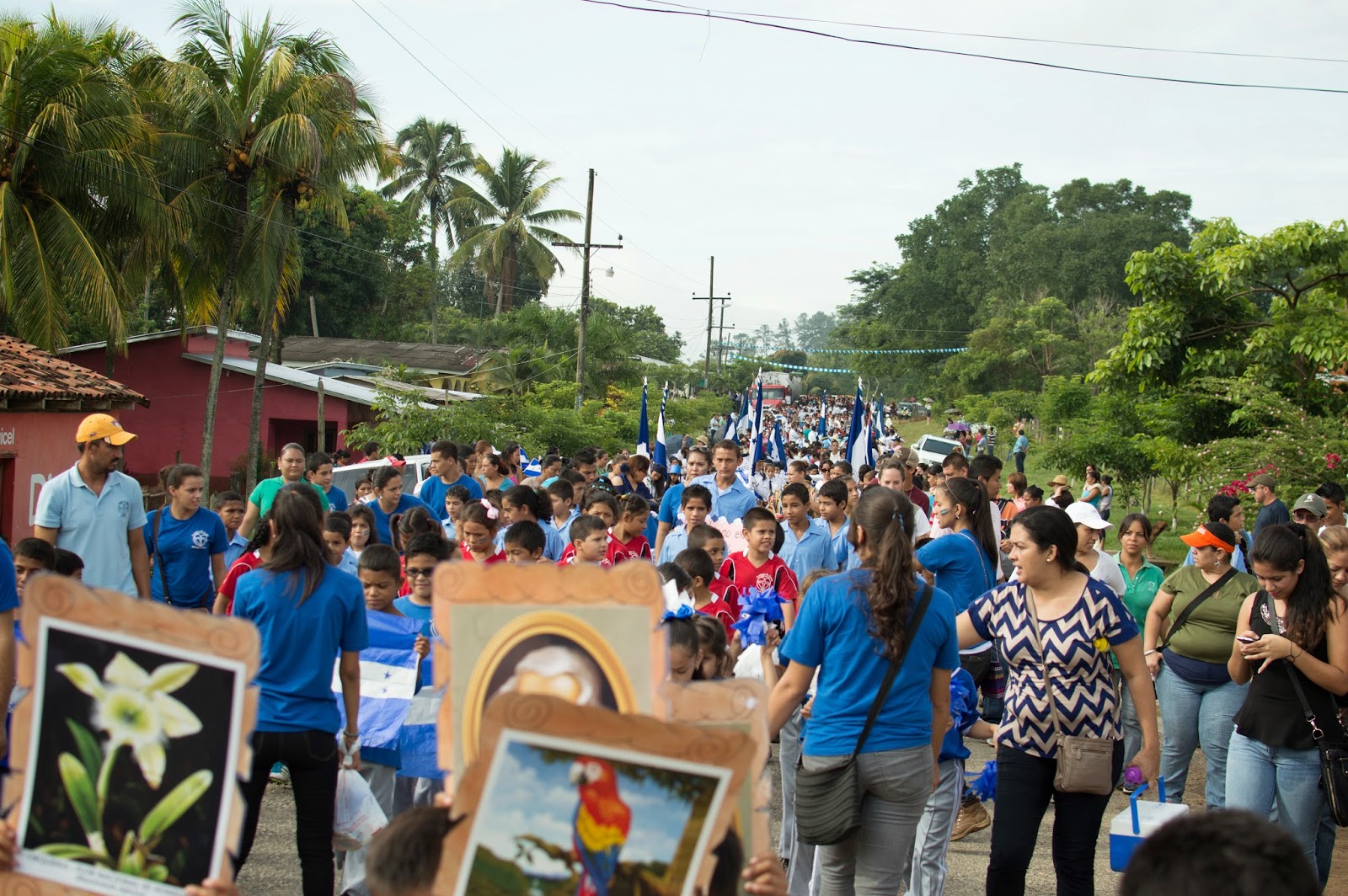
On the morning of September 15th every child, padrino, staff member and volunteer was up and ready by 6:30 a.m. That Monday, we celebrated Honduras’s independence day by marching in a parade. 

This year, Honduras celebrated 193 years of independence from Spain. Our kids joined many other neighboring schools in the patriotic parade and walked through the nearby town,  Macuelizo. 

Even the little kindergarteners walked all morning showing their pride by waving pictures of important leaders throughout Honduras’s history and sporting Honduras's colors: blue and white. 


On September 22, we welcomed back our children who were in the U.S. for two weeks. Victor, Ariel, Chango and Arcadia walked through the gates with beaming smiles and were full of stories. Thank you to everyone in the U.S. who helped make that trip so special. Our kids will remember it forever.


Thursday, August 14, 2014

First Days at Amigos

Hey everyone!

I’ve been here at the hogar (home) for 6 days now and what a time it has been! The day after I got here, we took all 120+ kids to a waterpark in a nearby town. A donor wanted to provide that to the kids so all of us were able to go. We spent eight hours there. It was extremely fun but ridiculously tiring.

I’m well on my way to learning all the names of the kids here. It’s a big task but shouldn’t take me too long. Between that and picking up on more Spanish, my brain is being kept very busy!In the mornings this week, we have been rotating through work at different spots here. On Monday I was in the kitchen. I chopped a lot of vegetables and then helped make tortillas for everyone. Once a month the volunteers cook a meal for the entire hogar. I’d like to thank SHC campus ministry on a head start on knowing how to cook for that many people! On Tuesday, I went to summer camp with the chiquitos (the youngest children we have here). Since they have a break from school right now, we got to do crafts and watch cartoons (a rare treat). On Wednesday I worked in the morning in agro (agriculture/farm). It was a lot of work but I enjoyed it! The Amigos de Jesus farm has pigs, chickens, horses, cows, corn, pineapple, lemons, papaya, mahogany trees, and various other small crops. However, we are in a severe drought and we may end up losing most of our crops this year. On a good year, Padrino Wilson (Amigos de Jesus director) said the farm could provide about 50% of the food we consume here. Thursday, the volunteers went to one day of training for the other group of volunteers that are here for almost a year, the BECA (Bilingual Education for Central America) volunteers. They are full-time teachers. On Friday I will be in esculita (summer camp for the slightly older kids).

The school here on site goes through 6th grade. After that, kids who graduate from our school will go into the local town to go to collegio (high school). After that, we have a couple kids in the university at San Pedro Sula.

For the first time in my life, I have washed my clothes completely by hand. It’s a time consuming task but I actually really enjoyed it. It’s nice relaxing time to listen to music and think.
My washer
My dryer
The volunteer house
This weekend, we have our first offsite trip with just our volunteer group. We will be going to Lago Yoja. This is one of the only lakes in Honduras and is supposed to be really beautiful with lots of things to do! We are all pretty excited!

Almost every night here ends with a prayer circle. It is, without a doubt, my favorite part of the day. Everyone gathers into a huge circle, holds hands, and the ones who want to take turns thanking God for what they are thankful for. A little girl who has become attached to me held my hand during prayer circle and took her turn thanking God for different things, one of which happened to be the fact that I was there. Talk about powerful!


-Michael Kernahan, volunteer 2014-2015

Friday, August 1, 2014

A Year Of Many Names


One of the first overwhelming things about starting life at Amigos de Jesus was something that I hadn’t thought about for one second. I worried about not knowing a word of Spanish before boarding a plane to Honduras. I worried about boarding a plane that would land in San Pedro Sula, the city with the world’s highest murder rate. I worried about all of these things complicating my marriage, which was not yet a month old. But neither Ali (my wife and my motivation to volunteer) nor I thought for a second about having to learn a bunch of new names. Through the application process we easily set to memory the major players: Fr. Dennis, Emily Ford, Amy and Wilson Escoto. Once we got here it was fairly easy to learn the volunteers’ names, as they were Americans like us and we spent ten days living in a house with them. The kids’ names were another story.

Ninety new names was plenty, but as you may have thought, but I never did, the names in Latin America are a little different. Jose, that’s easy enough. But it was a little harder a few minutes later when I met Josue (Hoe-sway), and than felt hopeless the next day when I met Jesuan (Hey-swan). Also, we have a Jose Antonio, a Jose Alexander, and a little girl named Maria Jose.  

The group of Jose-ish names was just the start of the challenge. Knowing kids names allows you to get their attention and avoid too many awkward “hey there …buddy’s.” To live in this world you also need to know the nicknames. If you insist on political correctness, well come down and change the culture yourself. We have a “Chinito”— little china boy, “Mata Perro" – dog killer, “Negro” and “Negrita” – black man and little black girl, “Chucho" – puppy, “Chango" – monkey, “Chimpa" – short for chimpanzee, “Cabeza" – big head, and “Shrek” – the resemblance fades as he is thinning out and bathing more consistently. You don’t have to use them, but this is all information you need to know if you want to understand what the kids are saying to one another. Though at times, it’s better not to know.
Shrek

Eventually we all figured out the names. Counting the staff, plus kids, the total number is about 160 names you need to know. Some of my favorite names are Virgilio, Otilio, Pipo, Ivis, Henrry (roll the double Rs if you can), Arcadia and her little sister Cleofis, and Fany. It took me about two months to commit the last of them to memory.

Tomorrow is the last day I will be called Padrino. Padrino is my job title; Madrina is my wife’s. The words translate to godfather and godmother. But those weren’t the only names we have been called this year. I have gotten a lot of “gringo” - white man, “viejo" – old man, (which was funny because I am 25 and look about 18) and “perro” – dog, which makes more sense as an insult here because the dogs are filthy animals. Surprisingly, about six months passed before anybody bothered to call me “cuatro ojos" – four eyes. I will spare you the bad words which I have been called in some of our children’s less charming moments.

Padrino is the name I will miss the most, which is ironic, because it represents a job that was absolutely exhausting to me. It was exhausting because being a Padrino requires the Honduran staff, and for 1-year my wife and I to do what is not possible. The Padrinos work at Amigos de Jesus to compensate for parents, and they fail every day. It is not the fault of the Padrinos, it is not the fault of Amigos de Jesus, there is no compensating for the absence of parents, there is only attempting and failing. They will continue to fail every day as long as Amigos de Jesus takes in kids. They wake up too early, and stay up too late. They clean clothes, bodies, and toilets. They get hit by fists, spit at, food and rocks thrown at. They do what parents do, but they are not parents.  “Godparent” is a good name for them. Not only because they fulfill the responsibility of godparents, but because it reminds us that we are working for and living with God’s children. The children who at times scream at, spit at, and hit us, are the same ones that turn into responsible young adults like Keka, who just spent months working hard to pass a test that will allow him to go to college. Amigos de Jesus – Friends of God, is a good name for this home. Padrino is a good name for the workers, because they are raising God’s children. 

-Pat Kenny, volunteer 2013-2014

Thursday, July 31, 2014

These are OUR children

In the midst of the crisis that is going on right now on our southern border, I have been thinking a lot lately about these children.  They are no different from the ones that we love, the ones that we care for, the ones that we work for every day.  They are no different than the ones that you support and write letters to and that we as a family pray for.  These children are fleeing violence, poverty and hopelessness and searching for a safe place to call home.  My heart breaks when I think about everything they have been through.  It breaks when I contemplate everything that lies ahead for them.  My heart breaks to think that they will return to their own countries only to begin the horrific trip again.  How much do you have to love your child to send them off knowing that you may never see them again, just so that they may have a glimpse at hope for a better future?  My heart breaks for the mothers that are making these decisions. 

One of the biggest challenges of doing the administrative work for Amigos de Jesús is that we have to try and connect people here in the US with a population of children far away; in a country that many do not even know how to locate on a map.  The suffering and the poverty is incomprehensible to many.  Living here in the US we are for the most part sheltered from seeing extreme poverty and feeling daily abuse.  But, Honduras is the most violent and dangerous country on the planet right now and now that these children are in our daily headlines and on our border, it is becoming real to us here in the US.  Children are regularly kidnapped, abused, raped or forced into gang life.  Families have no recourse as gangs work with impunity.  And the struggles are ongoing and constant.  Who wouldn’t want to escape that reality? 

God has allowed Amigos de Jesús to grow and more than double in size over the last few years.  He is not done with us yet, though, and as the need grows in Honduras, so must we.  By supporting Amigos de Jesús you are helping solve this crisis, for our country, for our family, for our children and for all the children that need us.  The children on our border are our children.  They are just like Victor, Ariel, Chango and Arcadia…the ones you will meet this fall.  They are the lucky ones.  They were brought to a place of hope and healing and are now safe from violence and despair.  They now have a family and have been provided for by people like you and me.  They have hope.  Most in Honduras, however, aren’t so lucky.   

I am so honored to be a part of this family and to know that what we are doing to so important to these children.  I am heartbroken at the thought of every other child in Honduras that has not found a safe haven, a place where they can be kids, free of fear and full of hope.  But, I am encouraged to know that all of you reading this are supporting our family and allowing us to reach out and help more and more children and do everything we can to make sure that they are safe and know that they are loved by a community of Friends of Jesus. 

-Emily Ford, Executive Director

Additional information on the crisis in Honduras:

Honduras currently has the highest murder rate in the world.  Gangs, violence, crime and extreme poverty are forcing children and families to look for an escape.  Here are a few resources to help you understand the complex issues at hand. 


Human Rights Watch – Honduras http://www.hrw.org/americas/Honduras

American-Born Gangs Helping Drive Immigrant Crisis at U.S. Border – National Geographic

Pope Francis-  "This humanitarian emergency requires, as a first urgent measure, these children be welcomed and protected. These measures, however, will not be sufficient, unless they are accompanied by policies that inform people about the dangers of such a journey and, above all, that promote development in their countries of origin." July 14, 2014 http://www.huffingtonpost.com/2014/07/15/pope-francis-immigrant-children_n_5588442.html


Finding a Family and Finding Home

Note: This is the full version of the article that appears in shorter form in our Summer 2014 Newsletter.


Gerson David on the way to meet family members.
Gerson David came to Amigos de Jesús in February 2008. Even in a home with so many children, all of whom come from unique backgrounds, Gerson’s arrival was exceptional. While most of our children are from cities and towns within a few hours drive of the hogar, Gerson came from the Moskitia, clear across Honduras and only accessible by boat or plane. And as a native Miskito, he did not speak a word of Spanish. Needless to say, the adjustment was difficult for Gerson. His temper flared up when he could not understand or be understood. Nobody really knew how he ended up in western Honduras, and much less from where exactly he had come. By the time he could effectively communicate in Spanish, he did not remember many of these details. As the years passed, he continued to adjust to Amigos de Jesús but forgot even more his family, his past and his native language.

Now 18 years old, Gerson is fluent in Spanish, learning welding in the mornings and studying in 8th grade after lunch. His formerly explosive temper has been replaced by a fun sense of humor and what is known as “The Greatest Smile at Amigos de Jesús.” But for all of the years that had passed, still we knew very little about him, and it was unclear what he himself remembered. So when a great opportunity presented itself to accompany a group from North Carolina on a mission trip to a Miskito orphanage, we jumped at the chance. The goal for the trip was to get Gerson back in touch with his culture, and if at all possible with family members as well.

We arrived by plane in Puerto Lempira on a dirt landing strip that is the gateway to the Moskitia. The whole town is about the length of this landing strip and is situated on the shore of a lagoon bordering the Caribbean Sea. Everything must arrive by air or by sea, so even the most basic necessities are rather scarce and expensive. There are two power companies, but between them there are still only 6-8 hours of electricity each day. All residents speak Miskito, and while in the city most people also speak Spanish, many have clearly learned it as a second language. We would stay here for a week.

The information we had to begin the search was very limited – Gerson only remembered a handful of first names and could not remember the name of the community where he grew up. He also was overwhelmed the first few days (understandably), so we took it slow and spent most of our time at Mama Tara’s Miskito orphanage with the kids and the group there. On day three, we hit the pavement to really start the family search. After a morning of collecting phone numbers and information in town from people who wanted to help, but were ultimately unable to do so, we stopped at a street corner that Gerson, upon arrival, had recognized as the place where his grandmother would sell fruits and fish. Unfortunately, hers was not one of the names he remembered. I waited for someone to ask what I wanted, to be sure that the person I was speaking with knew Spanish, and then phrased my inquiry something like this: “I’m looking for a woman whose name I don’t know who used to sell things here, who has a daughter named Felipa and a grandson who was taken out of the Moskitia sometime before 2008. Do you know who I’m talking about?” After a brief discussion in Miskito between a few of the older vendors on this corner, the woman looked back and told us in Spanish “That’s his family over there.”

The two family members on that corner turned out to be just the tip of the iceberg. They were siblings of Gerson’s great-grandmother, the one he remembered as his grandmother. Gerson did not remember them, but the more they talked to him, the more his face began to light up as he remembered some people and stories. Then they mentioned that he has a lot of family in Puerto Lempira, and a lot more in Pranza, the community in which he grew up. They helped us get in touch with more people, and that evening almost 15 extended family members, plus Gerson’s former teacher, came by the hotel to say hello. They invited us over the next day, saying they’d pick us up at 8:30.

Gerson David, reunited with family members.
That following day was full of excitement both for Gerson and his family. What was meant to be only a morning get-together turned into an all-day event. His family is spread among three houses in Puerto Lempira, but all of them came together that day to one house. There were about 30 people total: cousins, aunts and uncles, great-aunts and uncles, second cousins. Slowly I started learning and Gerson started remembering more and more about his life prior to Amigos de Jesús – about parents who had abandoned him, the great-grandmother who took care of him, and how a man claiming to also be family had convinced her to send Gerson to the other side of the country with him in 2006. His great-grandmother regretted her decision, they told us, and just before she passed away three years ago had left his birth certificate with an aunt with the instructions to keep looking. They had heard he was in Tela, in La Ceiba, and that he was dead. Most of the family was resigned to never seeing him again.

After talking about the painful part of his past, we began sharing happier details. We told them how well Gerson is doing in school and in his welding work, that he has learned Spanish, and that he has grown up to be a very polite and friendly young man. They, in turn, told us stories (some of which he remembered after hearing them) about a Dennis the Menace-like child, one who once burned down his great-grandmother’s house while trying to cook in secret. We were able to continue meeting up over the next few days with both the mother’s and father’s side of Gerson’s family. But as much as Gerson was enjoying his time in Puerto Lempira, one thing was still missing – he wanted to get out to Pranza.

Gerson’s family put us in touch with a woman named Ingrid, who owns the only car that goes to Pranza, a community on the border between Honduras and Nicaragua. At five o’clock in the morning, we loaded into the tarp-covered bed of a pickup truck and set off for what ended up being a five-hour drive down a bumpy dirt road through the middle of nowhere. And I mean nowhere – the only sign of civilization along the way is a military outpost about three hours out of Puerto Lempira. We rode in accompanied by goods such as gas and soap that are only available in Puerto Lempira; on the return trip Ingrid brings the plantains, fish and other harvest to sell in town. Being in Gerson’s original home, things that used to seem odd started to make sense, for example watching him scale a coconut tree with just his hands and feet and then peel the coconut with his teeth.

Upon arrival, close to 30 more family members, including his grandmother, were already waiting for us. About half spoke only Miskito, and the other half spoke Miskito and bad Spanish. We again repeated the story telling and Gerson got to see the community where he used to live, a collection of 40-ish homes and a church and a school, all spread through the same general area of the forest. It was an exhausting day, both physically and emotionally, and by four o’clock in the afternoon we were back on the road to Puerto Lempira, where the following day we would wrap up our trip before flying back out.

As daylight was fading and with the car stopped, Ingrid was cutting up some spare wire to hook the car’s headlights straight to its battery. She had no replacements for a blown fuse, so this was the only way to turn the lights on and get back that night to Puerto Lempira. She looked up at me in the truck’s bed and said, “You are going to have a good story to tell.” She could not have been more correct, although she did not know how great of an understatement she had just made.

For her, the good story was about the car and the travel of the day. But the good story is really about a boy who did not know where he belonged or what would become of him, but now has direction and goals in his life. It is about a successful search for one of our children’s past and the belief that it will help him in the future. It is about a young man who travelled across the country to find his family and his home, and at the end of the week travelled back to his family and his home at Amigos de Jesús.

-Alan Turner, Leadership and Independent Living Coordinator

Thursday, July 24, 2014

My Trip to Amigos

Now that I’ve been there I “feel” the knowing. To enter the gates of Amigos, with all the children eager to welcome us with hugs, was more sensory and visual input then I was able to absorb. There was a serenity that blanketed the scene; a surrealism about it. As we joined the children at play, and entered their “comedor” to eat with them, the thought kept passing through my mind, “boy, I feel as though I am on a National Geographic special, in a third world…wait, I AM in a third world country, and this is what it feels like: hot, dirty, tiresome, and oh so simple.” Images still snap through my mind of the children: always being affectionate, of them cleaning their dishes with buckets of water, of them patiently watching us eat our meal to see if we might have some leftover that they could finish, of their large, dark eyes so attentive to you in trying to communicate, and of their prayer of  “Thank you, Father” during prayer circle where we gathered at night, holding hands, reflecting on the day. 

The layout of Amigos gave the impression of a retreat center, multiple buildings, spread largely around rolling terrain, a woods path to the school, and large playing fields. And I thought, in a way, that for the children they had “retreated” here, to a safe haven, away from the extreme difficulties their life had once known. There was safety here, serenity here, and there was love. It struck me, not only from the children, to me and my other daughter who visited with me, but in observing the padrinos and madrinas, the other Honduran staff, and from the gringo volunteers, there was immense love, displayed in their patience, their smiles, their presence.


Now that I’ve been there, I “feel” the knowing of extreme fatigue, extreme heat, where you can find no relief, and the need for extreme perseverance to plug through very long hours. It is awe inspiring how the volunteers have done it, how they can get pass the physical and mental strain, and say they love it, and that leaving will be a bittersweet.  True, the kids are beautiful and amazing to have weathered more hardship then any child should ever have had to, but it was the volunteers who really stole my heart (and not just because one is my daughter!). Their spirits were vibrant with the light of the Spirit.  There was a quiet peace about them all, they went through their day, not pretentious in proclaiming to change the world, or overly zealous in language or deed. But rather worked methodically and pleasantly, interacting with the children with great compassion and humor, they were, in the words of St. Teresa of Avila, “the feet with which Christ’s is to go about doing good, and the hands with which Christ is to bless all people.”

And so, now that I have been there, I am glad, and I am changed by all the many experiences I had and witnessed. And I now know that Amigos has been changed, for the better and for good, because six very special, and dare I say, holy, young people, persevered to make it that way.

-Patricia Gardner, mother of Joanna Gardner, volunteer 2013-2014